
Petrovac: a guide to the beaches, history and town
Budva Riviera · Petrovac na Moru
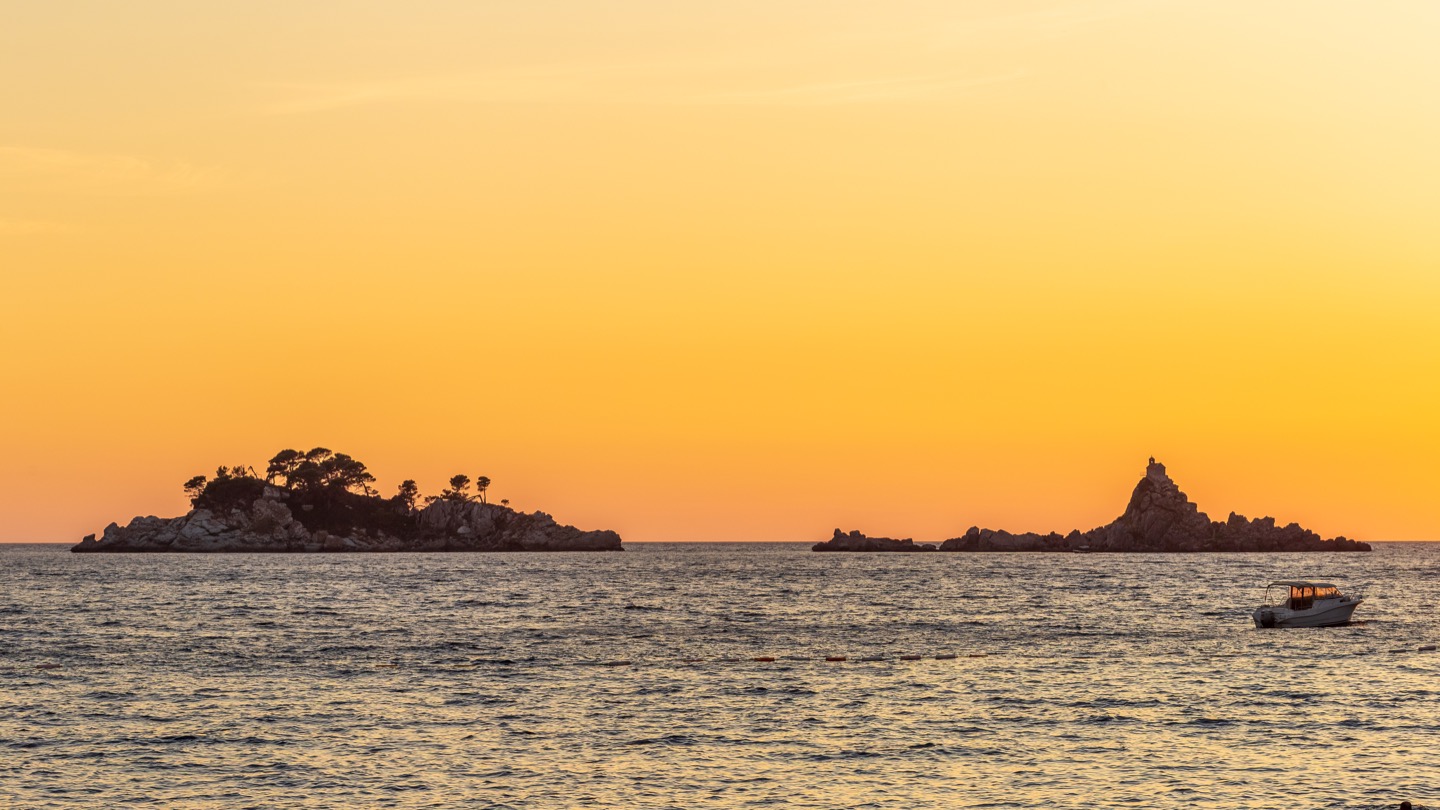
Two islands are visible from the shore. Katič and Sveta Neđelja in two photographs: which island has pines and which rock has a chapel?.
Stand on the promenade facing the bay. Kastio and the Lazaret occupy the rocky headland. Out at sea are Katič and Sveta Neđelja. A third landmark is tucked between houses at Mirišta, where a mosaic floor survives from a late antique villa. These three sites help explain the town. Add Lučice for a day at the beach, or Buljarica for a longer, open shore.
The mosaics at Mirišta: what was found in the olive grove in 1902 and 1941.

Where we are
Petrovac na Moru is a town in the municipality of Budva, farther south along the coast. Petrovac na Mlavi is a different town in Serbia.
What to choose
The town beach is right beside the promenade. Lučice is a smaller, separate bay. Beyond the next headland, Buljarica has a longer stretch of shore.
What to see
Kastio and Lazaret, the late antique villa in Mirišta, the cultural center of the Red Commune, the islands of Katič and Sveta Neđelja.
Finding your bearings: the sea in front, the hillside behind
Petrovac has a clear axis—a coast along the city shore. On one end there is a rocky show with Kastio and the neighboring Lazaret. Behind the line of coastal houses the city rises to the road and slopes. This simple geography is more important than the advertising promise “five minutes to the sea”: down you can really get fast, but in the evening you will have to go back up.
You can spend a day on foot around the bay, with time for the beach, lunch, a walk and a historical site. Beyond the bay, distances change. Lučice is the next cove. Buljarica has a long shore and a plain behind it. Reževići and the monasteries are a trip of their own. Check the actual address when a rental listing describes any of these places as central Petrovac.
The city is suitable for those who want to have the sea and everyday affairs nearby. However, compactness is not equal to loneliness. In high season short beaches, beaches and approaches to them gather a lot of people. For silence, a specific house, the side of windows, neighborhood with establishments and time of travel are important.
Map of Petrovac and its neighbouring coves
Find the town bay and the headland of Kastio first, then look for Lučice and Buljarica. The map shows how they fit together. Check locally whether the coastal path and monuments are accessible and whether parking is available.
Map data © OpenStreetMap contributors. Open the full-size map. The map shows Petrovac, the neighbouring coves and the coast as far as Buljarica.
Why do the postcards say Castellastua? on postcards sent in 1899 and 1913 the old town name is still printed. The new name was chosen at a town meeting in 1919. Read how one voice determines the fate of the name.
How visitors found the mosaic in 1964
In Jovan Martinović’s pocket guide in French, Budva – Petrovac – Sveti Stefan the visitor’s landmark was the Gregović family olive grove. The author places a surviving floor fragment with geometric and plant motifs there. Nearby entries list Kastel and the Lazaret, already adapted for visitors. This is a small map of Petrovac before navigation apps: the plot takes its name from a family, and the waterfront buildings from their former uses. Source: the Belgrade edition of Jugoslavija, 1964, section on Petrovac monuments.
Four beaches – four different days
The town beach: an easy walk back
The main advantage of the city beach is the proximity to the rest of the day. You don’t need to turn every swimming into a separate trip: things can be left in the housing, back for lunch, again out to the water. The coastline gives the opportunity to be at the sea and those who do not intend to burn.
Comfort has the opposite side: here visitors of the city and resting from the nearest houses are gathered. If you are planning to spend on the beach all the day, evaluate in advance the free area, coverage at the entrance to the water and the possibility to hide from the sun. The beautiful view of the islands does not tell about the depth or the tension in a particular morning.
Lučice: a small bay beyond the headland
The tourist organization Budva describes Lučice as a hole between the two mountains with cows and cyparis, approximately a half-kilometer south of Petrovac. The length of the beach is about 220 meters. The scale here is cameral: the beach is easy to cover with a view, but the space is limited.
For the choice of housing, this is a significant difference. “Right to Lučice” and “on the Petrovac coast” are different daily routes. Check the walkway from the door, not the distance to the center of the shore straight. The trees around the beach do not mean that the chosen place at the water will be in the shadow all day.
Buljarica: the long beach and the wetlands behind it
Farther along the coast towards Bar lies Buljarica. The official tourist guide describes a beach about 2,250 metres long, with stretches of sand, pebbles and rock. The low-lying wetland behind the beach is part of what makes this stretch of coast worth a visit, even when there is plenty of room on the beach in Petrovac.
Here it is more reasonable to choose a specific area than to drive «on Buljarica in general.»Distances to water, food, housing and entrance differ.If you prefer a more remote part of the coast, make a prior decision on the issues of water, shadow and return.The large length of the beach does not guarantee the same convenience throughout.
Perazića Do: check the path before setting off
This shore is often included in stories about a coastal walk from Petrovac through tunnels. Here it is ⁇ important to separate a beautiful route from the old report from today’s conditions. Closed passage, damaged area or work change the walk entirely. Check the state of the road on the site; the curtain is not an invitation to look for a passage on the rocks.
For the first day with small children or limited mobility, it is better to choose a clear path with predictable return. Planning a walk on a complex beach separately from the beach day.
| The coast | When to choose | What to check |
|---|---|---|
| The city beach | For a beach close to your accommodation and the promenade | How busy it gets, space for your towel and noise near the property |
| Lučice | For a smaller, secluded cove | The approach on foot and shade where you plan to sit |
| Buljarica | For a longer stretch of beach | The stretch of beach, road access and distance to facilities |
| Perazića Do | Ready to plan the road and walk separately | Whether the path is open, its surface and the return before dark |
To compare these beaches with others on the riviera, open Our beach sectionCity holidays in Petrovac, Long Beach Jaz and the bay at Pržno They solve different tasks.
Where to stay: try the walk from the front door
Coastal and lower parts of the city
It is suitable if you want to go out to the sea several times a day and return without a long lift. Before booking, check the location of the bedroom, work of neighboring facilities, the possibility of climbing with your luggage and the real place of parking. «See View» can mean a successful balcony and at the same time a vibrant street under the windows.
streets above the shore
On the slope the perspective changes: the city and the sea become a panorama. Together with the panorama appear stairs and curves. Ask the owner to show the continuous path from entrance to the coastline. For the wheelchair, the elderly person and returning with shopping this is useful photo of the pool. Also specify the floor, the elevator and the last meters to the house — the navigator can lead to the nearest road point rather than to the door.
Lučice and Buljarica
This choice is justified if these beaches will be the center of your rest. Compare not only the price of the room, but also daily shifts: where to breakfast, buy products, pick up a car, wait for a taxi. Buljarica is a separate place, not the remote Petrovac coastline.
Is there a fixed parking place? How many stairs on the way to the sea? Where are the bedroom windows out? What works near your dates? Can you get to the beach by ordinary road without using closed passages? Answers should refer to the specific address.
Kastio and Lazaret: Defense, Trade and Quarantine
The story of a big plan: Kastio and the Lazaret: the garrison, drawbridge, trade and quarantine by the seaA separate article with real photographs and the discovery of controversial dates.
On the edge of the coast, the shore is risen by a rock. Today this speech first and foremost attracts the look: from here it is convenient to look at the shore. For the former Lasta, the meaning was different. The one who controlled the approach to the shore, controlled the possibility of relaying, loading goods and getting into the settlement.
Why the fortress stood here
The Budva Museum and the tourist organization relate the Venetian fortress of Kastio to the 16th century. The names of Kastio, Castelo and Kaštel Lastva are found in different descriptions of one historical place and settlement. It is useful to remember when reading books: changing the writing does not necessarily mean another fortress.
In the book «Budvanske tvrđave» the former Castello is described as a high tower with economic buildings. It reminds of the lifting iron bridge — «left». On the night the passage could be closed. This detail returns to the strengthening of its destination: today opened the visible point was once a space with controlled entrance.
Not only weapons were kept behind the walls.
The same book describes rooms for weapons, wine and olive oil. The tourist organisation also records warehouses for goods shipped by sea. The fortress had military and commercial purposes: its defences protected people, supplies and access to the sea route.
The products came to the port from the surrounding land, and the maritime connection brought a small settlement beyond its own shore. Therefore, the history of Petrovac is linked to Paštrovići — their land, family relations and local governance. the sea expanded its possibilities, but did not eliminate its dependence on the coast.
Lazaret: a stop on the sea road
Near the defence existed another way to control arrival – carantine.Lazaret is linked to the isolation of those arriving during epidemic danger.It cannot be automatically represented by a modern hospital: the task of the carantine institution was primarily in separating people who caused concerns from the rest of the population.
The city needed the movement of ships and people, but sometimes it had to stop this movement. For a person who arrived from the sea, the beach could mean waiting. For the residents of the settlement, the same delay was a attempt to protect usual life.
It is not worth attributing Petrovac to the institution the unchanged forty days of quarantine or a detailed order without a specific document. The name itself does not report how long the isolation lasted in each case, who was placed here and what rules were in force in a given year.
Why the complex has no single construction date
The sources describe different stages. A short museum reference connects Kastio and Lazaret with the Venetian XVI century. The illustrated edition «Božanstvena Budva» tells about the formation of the Lazaret appearance by the end of the XVIII century and the subsequent Austrian translation. In «Budvanske tvrđave» the late date is formulated differently. Referring these data to one exact date without special research would be wrong.
It is more important to read the complex as a sequence of rebuildings: early consolidation, development of coastal infrastructure, change in military needs, new use. It is important not only the age of the stone, but also what parts have disappeared, which were adapted, and which are familiar to us already in the late form.
The fortress after Venetian rule
Local histories describe the dismantling of the tall tower and construction of a terrace under Austrian rule. The Lazaret served as a storehouse and service quarters; accounts also mention a military kitchen, the kužina. What we see today bears the marks of these later uses as well as the Venetian defences.
What makes Kastio so revealing is how many uses of the shore still share one site. First came lookout and defence, then accommodation and supplies for the garrison, later visitors. Facing the sea, look for the line between the defensive headland, the buildings and the landing stage. The history is visible in their arrangement.
This shore has a continuation.
The fortress explains the structure of the coast, but not the entire life of its inhabitants. The Great History of Petrovac tells of the Gregović family, work overseas, local government and cultural life. Our article on Paštrovići in Venice They show the reverse side of the Adriatic: work, family and relationships with the homeland.
Mirišta: city under the city
In Mirišta is a Roman villa with mosaic fields. The Encyclopedia of Fine Art of the Black Academy of Sciences describes several construction phases of the complex — from the end of the I or beginning of the II century to the first years of the VII century. Therefore, the expression «mosaic IV century» should not turn into the date of the entire villa.
The excavations revealed rebuildings, new premises and traces of economic activity, including the production of olive oil. The idea of the villa as a beautiful room with a pattern on the floor is too narrow: it was a living, changing space. The decoration of the house was close to work.
The famous motivation of three fish with a common head refers to the history of discovered and lost fragments. Don’t promise the child to see on the site exactly the picture they found on the internet. Access to the archaeological object and accompanying must be clarified at the museum; the publication about its discovery many years ago is not today’s schedule.
To see the difference between Petrovac residential archaeology and Budva funeral archaeology, read about Necropole and underground floors of BudvaIn one case, the researcher collects the story of the house, and in the other, the story of society on how it was forgiven with the dead.
When four resorts sat down together
On Sunday 5 March 1933 the Petrovac delegates spent the morning in Budva. From nine until one, representatives of four societies met: Mogren of Budva, Rivijera of Sveti Stefan, Nehaj of Sutomore and Primorje of Petrovac. Petrovac already had eight years of experience in this work. Primorje had been founded in 1925.

Seven years earlier, the neighbouring towns had already been invited to meet. The proposed venue for that evening was the olive cooperative hall in Pržno. Budva’s refusal survives on the reverse of the invitation. In 1933 the four societies went further: they signed a cooperation agreement and adopted a three-year plan. Details would follow when each town supplied its own figures. Ante Slovinić, editor of Glas Boke, reported on the meeting from the room itself.
Lučice Bay figures in that story too. The newspaper singled out Savo Vuković, the municipal president, who was building a hotel there on his own initiative. Residents could help draw up a shared plan for tourism, while an individual supplied the money and took the risk of construction. The report confirms building work. It gives neither an opening date nor a street address.
The story of the missing dinner in Pržno · Who helped Budva from Belgrade.
Miroslav Luketić, Kulturna baština I, pp. 175–177. Letter No. 618 of 19 July 1926, with the reply on the reverse. Glas Boke, issues of 18 March 1933 and 24 July 1937, as cited by Luketić.
The islands, monasteries and lands of the Paštrovići
Katič and Sveta Neđelja: the pines and the bell tower
From Petrovac’s promenade first find the rocky island with trees: that is Katič. The museum catalogue dates the planting of its pines to the years between the world wars. Look next at the neighbouring summit. The chapel of Sveta Neđelja stands on the bare rock. Marine protection documents also call the island with the chapel Mali Katič. The trees and the roof are better clues than left and right because the view changes from the Kastio headland.
In the «Letops of Pope Duklanin» on the shore of Lasta, the escaped king Radoslav float reaches the rock. It is picked up by sailors from Apulia and carried to Sipont. Vlado Duletić suggested that the «Radoslav stone» could be Katič. In the history of the island is not named Katič, and it is not possible to confidently recognize it by this description.
Sveta Neđelja has its history of salvation and its exact date: in 1897 the rocky church was already repaid. Therefore, the church was older than the 1914 maritime battle, after which the sailors of Zenta were saved here. See the chapel up close and read the surviving accounts of its restoration.
V. Duletić, Budva — Od mita do stvarnosti, pp. 79–81, and the museum catalogue on the cultural landscape of the Budva coast.
Gradište: a monastery where generations learned to read
Gradište Monastery stands above Buljarica. The book Manastir Gradište describes what the monastery meant to nearby villages: children learned there, documents were kept there and parishioners gathered there. These everyday roles help explain the place of small monasteries in the life of the coast.
In the same book, the tradition of creating a literary, printed in Venice in 1597, is linked to the monastery environment and the outgoers from Paštrovići. Here again appears the Adriatic: the sea connected not only the markets, but also the people, the books, the religious and educational connections. The local edition serves as the source of this attribute; the place of printing and the history of the composition of the book are different issues.
Reževići and the neighbouring villages
A trip to the direction of Reževići leads from the resort shore to another landscape: villages, cliffs, old roads and monastery life. Do not unite all the monasteries of the river into one list «for an hour». Choose one place and leave the time to consider it quietly. For the current temple, specify the order of visit and recording.
A broader context the history of the Bankada and its court and the Sveti Stefan to the Hotel Age. Together these places tell the story of one coast.
How to get and move
Petrovac and Budva are linked by the coastal road. For bus travel, start with the Budva bus station: check the service, boarding point, arrival stop and bus home. Intercity departures and local routes have different timetables. Mediteran ExpressA carrier’s name in a guide does not confirm that the service runs on your travel date.
From the airport, compare the whole road to the housing, including the transfer and the last part with your luggage. Do not put a fixed time on the journey along the summer coast. morning road bulletinThe road report reports restrictions, but is not a real-time map of tracks.
A car is useful for visiting places scattered across the hills. In town, check where you can park. Ask your host for the precise location and parking terms, and check local signs when you arrive.
How to collect a trip without a race on points
If you have a few hours
Leave the base on the coast, shore and Kastio. They are enough to understand the city’s layout. If you’re interested in archaeology, check out the conditions of visiting Mirišta in advance and set a day under it. Do not try to put a closed monument between lunch and bus just because it’s close to the map.
If you come for a day
Pair a beach with one place to visit: Lučice and Kastio, the town beach and the museum, or Buljarica and Gradište. Check access before setting out. In hot weather, save the uphill walk for the cooler hours. In rough weather, choose an outing on land instead of a boat trip.
If you stay for a few days
Spend your first day getting to know the town: try the walk from your accommodation, find your favourite place to swim and see how long everyday trips take. Then venture farther afield to Reževići, Buljarica, Pržno or BudvaIt’s better to see less places carefully than spend most of the holiday in search of parking.
Season, food and budget: what really is worth checking
In the high season, the choice of operating facilities is wider, but more and the load on the coast. In the intersection, it is more important to check the kitchen hours, bus departies and the availability of services in advance. The phrase «Petrovac is open all year round» doesn’t say anything about a specific restaurant or beach rent.
The hot day does not guarantee warm water, and the average month temperature is not the measurement today. specify the date and place of measurement. The forecast for the neighboring aquarium cannot be signed as a measurement on the chosen beach.
For the budget, separate housing and road from daily expenses: food, parking, beach equipment, boat. Do not focus on untold prices tables from different guides of years. In the menu check the price unit — a portion, weight or whole fish; in the beach set — what is in and for which period. This allows you to compare offers without the fictitious «medium cost of holiday».
Questions before the trip
Petrovac – a separate city or district of Budva?
Petrovac is a town on the Budva Riviera, within the municipality of Budva. It is a separate trip from central Budva.
What is better for a child – the city beach or Lučice?
Choose by the age of the child, entrance to the water on a particular day, shadows and the way from the housing. The city beach is easier to return to the center; Lučice is a small separate shore. No one of the options guarantees a quiet sea and a free beach.
Can we live without a car?
Yes, if the daily plans are focused near the shore and the housing is chosen with a convenient walking approach. Travels on the river will require a separate planning of the bus, taxi or transfer.
Where to find the old city of Petrovac?
There is no mural of the old city of the scale of Budva. Historical dating consists of Kastio and Lazareta, coastal buildings, Mirišta and cultural institutions. Don’t wait for a reduced copy of Budva.
Can visitors see the Roman mosaics without arranging access?
Current access and accompaniment please specify at JU Muzeji i galerije Budve. The monument’s reputation and its mark on the map do not mean it is open at any time.
How accurate is the map in this guide?
The map uses OpenStreetMap data. Follow road signs and local restrictions, and check the condition of paths. Before leaving, save your accommodation address and your boarding point as two separate pins.
Continue to meet with the Riviera.
What is the guide based on
Check: November 6, 2026. The thematic sections of the books “Budvanske tvrđave” (Kastelo and Lazaret, p. 34–36), “Božanstvena Budva” (Kaštel Lastva, p. 84–85), “Manastir Gradište” (2016, section on Treasure and Literacy); materials JU Muzeji i galerije Budve and the Tourist Organization Budva on Petrovac, Kastio, Lučice and Buljarica; article of Tatiana Koprivica on the villa of Mirišta in “Leksikon likovne umjetnosti Crne Gore”, CANU.
Montenegro.com, Adriatic Ways and the blog «Black HISTORY» are used as additional guidelines for traveler’s research and questions. Their texts and photos were not copied. Unconfirmed current prices, accurate access hours and seasonal promises in the guide are not included. Historical legends are labeled as legends; dates differences are preserved.